

College Applications
Class of 2027 Summer Checklist
College Application Guide
Three Tips for Success
- Read your email. Every day.
- Be an active participant. Students, this is your future.
- Ask questions and ask for help when you need it.
The MUST Do List for Summer
- Research colleges
- Complete the Student Brag Sheet if you are required to have letters of recommendations
- Have a parent/guardian complete the Parent Point of View (Parent Brag Sheet)
- Come back in September with a core group of schools that will make up your college list (it's ok if it's not final).
- Register for the SAT and/or the ACT, if you plan to take them (register ASAP because seats are hard to come by)
- Relax, reset, and spend some time away from your computer!
The Strongly Encouraged Additional To-Do List for Summer
- Visit some college campuses in person
- Start to pull together the requirements for each school
- Types of applications accepted
- Deadlines
- How many letters of rec
- Special requirements, etc.
- The best place to find the most current info is on the university's admission website. Look for something like "How to Apply".
- College Application Tracker, a spreadsheet you can modify for your needs
- Improve (or re-write) your main application essay.
- Here are some brainstorming exercises, if you need to start over.
- College Essay Guy (CEG) has the BEST free resources out there for essay writing, including supplements and school-specific essays (like the UCs).
- Start working on your activities list. I like to work in Google Docs first.
- Create a Common Application account (assuming you're using the Common App) and start working on it.
- Between now and late July, you can create your account (students should use a PERSONAL email address) and work on the "Common App" tab.
- The application will go down for a few days at the end of July and will "rollover" to next year's application on or about August 1.
- The info you have on the "Common App" tab (and all its subsections) will save.
- The school-specific info on the "My Colleges" tab will be deleted.
- Do not get excited about supplement essays until after August 1 - they might change, so best to wait until August for those unless the school has announced their supplements elsewhere, like on social media.
Parent/Guardian To-Do List for Summer
- Complete the Parent Point of View (Parent Brag Sheet) over the summer.
- Visit some college campuses in person.
- Have a few open and honest conversations with your child about parameters for their college search, including finances.
- Complete net price calculators for a few schools on your child's college list - especially if they are considering applying Early Decision (ED) (Pro Tip: Google: "collegename net price calculator").
- Encourage and support your child through the application process, while resisting the (sometimes overwhelming) urge to do it for them.
Building a College List
Building a College List
Finding the Right “Fit”
Deciding where to spend the next two or four years is important, and it’s an individual decision with many influencing factors. It’s important that a student consider the right “fit” in selecting their destination.
We can think of fit as a pie chart, with three areas. For some families, those areas are equal - and for others, they aren’t. Each area can be more (or less) important, but they all need to be considered.
Below is a starter list of factors that might fall into each category. You can probably think of a few more that are important to you and your family.
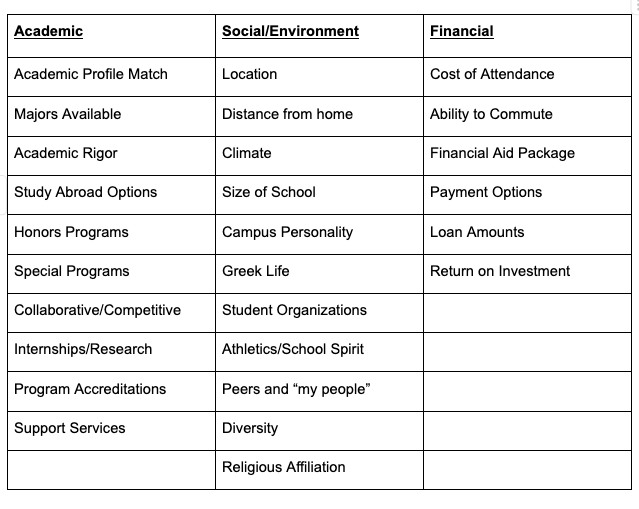
Constructing the College List
In considering college options, it’s important to know that your college list will get longer before it gets shorter. It’s not a bad thing to have 20 schools on your list at the end of junior year! This means that you are keeping your options open, and hopefully considering a wide variety of institutions.
By the start of senior year, though, the hope is that you will have narrowed your list to a more reasonable number. The average Petoskey High School student applies to 3-6 schools. In the end, your specific situation may dictate that you have a few less, or a few more, but this is a good guideline. A well-crafted list means that a student will not spend all of senior year completing applications, writing supplemental essays, and stressing about making a final decision. The student will also have the time to craft specific, intentional applications to each of the schools to which they apply.
Remember, this isn’t about collecting acceptances like trophies - it’s about finding a great fit and “home” for this next step of life!
A well-structured list is going to have 2-4 schools in each of the categories below:
- Probable Schools: Student academic profile surpasses the college or university admission criteria. Chances of admission are highly likely. (Note: these schools may offer you the highest merit scholarships)
- Match Schools: Student academic profile is a match with the admissions criteria of the college or university.
- Reach Schools: Admissions criteria surpasses the student’s current academic profile. Those most selective colleges and universities (e.g. schools with admission percentages below 25%) are reaches for everyone - if you have a matching academic profile.
How can you find the information you need to determine which school fits in which category?
This is where XELLO comes in. Look at the analysis for each school to see where you fall. If you're using scores, also check out the averages and mid 50% ranges. Finally, use the Compare tool to look at your schools side by side.
Additional school-specific data can often be found on the college website, under a heading similar to “Freshman Class Profile”. Here are two examples:
Understanding how you compare academically to other students from our high school, as well as applicants from other schools, can be helpful when exploring college options. However, it is important to remember that these comparisons reflect only statistical academic information, such as GPA and test scores.
College admission decisions involve much more than numbers. Colleges also consider factors such as the rigor of coursework, grade trends, senior-year performance, intended major, and elective courses taken. In addition, a variety of non-academic factors may influence admission decisions.
These statistics should be used as a helpful guide rather than a definitive indication of your chances of admission.
Search Tools
There are countless search engines, but we’ve constructed a list of the most reliable, data-driven tools for research:
- College Board: BigFuture
- College Data: http://www.collegedata.com
- CollegeXPress: http://www.collegeexpress.com
- College Navigator: https://nces.ed.gov/collegenavigator/
- College Results Online: http://www.collegeresults.org
- Niche: https://www.niche.com/colleges/search/best-colleges/
Books:
Applications: Types of Submission Options
Types of College Admissions
Decision Plans
As you decide which colleges and universities to apply to, it is important to understand the different application options and deadlines available. Each institution offers one or more admission plans, with early application deadlines typically falling between October and December and regular or rolling admission deadlines generally ranging from November through February. Be sure to check each college’s specific deadlines and requirements.
Students who apply through an early admission option will generally receive one of three decisions:
- Accepted: The student has been offered admission to the college or university.
- Denied: The student has not been offered admission.
- Deferred: The college has postponed its decision and will reconsider the application during the regular admission review process.
A deferral does not mean a student has been denied admission. It simply means the college would like to review the application again alongside other applicants before making a final decision.
Early Decision (ED)
Early Decision is a binding admission option, meaning students who apply through this process agree to attend that college or university if accepted. Students may apply to only one college through a binding Early Decision plan at a time.
Because admission is not guaranteed, students are encouraged to prepare applications for other colleges in case they are not accepted to their Early Decision school. If admitted, students must withdraw all other college applications and commit to attending that institution, subject to the terms of the Early Decision agreement.
If a student is deferred, they are generally released from the binding agreement and may continue applying to other colleges through Regular Decision, Rolling Admission, Early Action, or Early Decision II, depending on each school's policies and deadlines.
Applying Early Decision may offer an admission advantage at some colleges. However, it is a significant commitment and should only be considered when a student is confident that the college is their first choice. Students and families should also carefully consider financial aid and affordability before choosing this option.
This video can help explain the Early Decision process.
Early Decision (Binding) May Be a Good Option for Students Who:
- Have visited the college, preferably more than once, and feel confident it is the right fit.
- Are certain the college is their first choice and would attend if accepted.
- Have carefully considered the cost of attendance and are confident their family can afford it. Students and families should use the college's Net Price Calculator and other financial aid resources before applying.
- Are academically qualified for a competitive college but may benefit from the potential admission advantage of applying Early Decision.
- Are strong academic candidates applying to highly selective colleges and want to demonstrate their commitment to attending.
Important Reminder: Early Decision is a binding commitment. Students and families should carefully consider academic fit, personal preferences, and financial affordability before choosing this application option.
Early Action (EA)
Early Action is a non-binding admission option that allows students to apply to colleges early in their senior year and receive an admission decision sooner than they would through Regular Decision. Unlike Early Decision, students accepted through Early Action are not required to attend that college and generally have until May 1 to make their final enrollment decision.
Early Action deadlines typically fall in October or November, with admission decisions often released in December or January. However, deadlines and notification dates vary by college.
Early Action (EA) May Be a Good Option for Students Who:
- Have a strong academic record through their junior year of high school.
- Have completed any required standardized testing in time to meet early application deadlines.
- Are organized, motivated, and able to complete all application materials early in their senior year.
- Have demonstrated consistent academic performance and plan to maintain strong grades throughout their senior year.
- Are prepared to submit a complete, thoughtful, and well-prepared application early in the college admission process.
Important Reminder: Early Action allows students to receive admission decisions earlier without making a binding commitment. This gives students additional time to compare colleges, review financial aid offers, and make an informed decision about where to attend. Some colleges offer restrictive or single-choice Early Action plans, which may limit a student's ability to apply early to other institutions. Be sure to review each college's specific policies before applying.
Restrictive Early Action (REA) or Single-Choice Early Action (SCEA)
Restrictive Early Action and Single-Choice Early Action are non-binding admission options that allow students to apply early and receive an admission decision without committing to attend. However, unlike traditional Early Action, these plans place restrictions on where else students may apply early.
These application options are less common but are offered by some highly selective colleges that may be of interest to PSP students.
Specific rules vary by institution. For example, some private colleges allow students to apply Early Action to public universities but restrict early applications to other private colleges. Other institutions may have different requirements or exceptions.
Important Reminder: Students considering REA or SCEA should carefully review each college's application policies before submitting applications to other schools. If you have questions or are unsure about the restrictions, contact your school counselor or the College & Career Counselor for guidance.
Some colleges and universities offer restrictive early application options or other early admission plans with specific requirements. Because these policies and restrictions vary by institution and may change from year to year, students should carefully review each college's current admission guidelines before applying.
For additional information, visit CollegeVine's Guide to Restrictive Early Action (https://blog.collegevine.com/what-is-restrictive-early-action-when-applying-to-college) .
Regular Decision (RD)
Regular Decision is a non-binding admission option that allows students to apply by a college's established deadline and receive an admission decision later in the school year.
Application deadlines typically fall between January and February, although dates vary by institution. Colleges may release admission decisions individually, in groups, or all at once. Some students may not receive their decisions until late March or early April of their senior year.
Important Reminder: Regular Decision gives students additional time to complete their applications, strengthen their academic records, and compare college options. Students should carefully track application deadlines and allow enough time to submit all required materials.
Rolling Admission
Rolling Admission is a non-binding admission option in which colleges review applications as they are received and release admission decisions throughout the application cycle, rather than on one specific notification date.
While Rolling Admission may offer more flexibility, students are encouraged to apply early. Colleges and individual academic programs may have limited spaces, and popular programs can fill before the final application deadline.
Important Reminder: Even if a college accepts applications on a rolling basis, applying early can improve access to available programs, housing options, scholarships, and financial aid opportunities. Students should check each college's priority deadlines to ensure they do not miss important opportunities.
Completing your College Application
Completing the College Application
Once you have identified the colleges and universities you are interested in attending, the next step is completing your applications.
Many colleges accept more than one type of application, but you should submit only one application to each college. Before getting started, review your college list and determine which application options are accepted by each institution.
Planning ahead can make the application process much easier. Whenever possible, use an application platform that allows you to apply to multiple colleges without completing an entirely new application for each one.
Application Options
There are several ways to apply to colleges and universities:
- Common Application (Common App): A widely used application platform that allows students to apply to multiple colleges using one general application. Most students will use the Common App for at least some of their college applications.
- College System Applications: Some groups of colleges and universities use a shared application system, such as the University of California system.
- Individual College Applications: Some colleges require students to apply directly through their own websites, while others offer this option in addition to the Common App or other application platforms.
Tips Before You Get Started
- Stay organized. Create a spreadsheet to track each college's application requirements, deadlines, fees, and submission status. You can use this College Application Tracking Spreadsheet to get started.
- Know your application limits. The Common App allows students to apply to a maximum of 20 colleges.
- Use a personal email address. Choose a professional email address that you check regularly. Avoid using your school-issued email, as you may lose access after graduation.
- Keep track of your login information. Store college application usernames and passwords in a secure password manager or another protected location.
- Ask about application fee waivers. Students who qualify for free or reduced-price meals or meet other eligibility requirements may qualify for college application fee waivers. Contact your school counselor to learn more about available options.
- Pay attention to deadlines. Application deadlines, scholarship deadlines, and financial aid deadlines may be different. Be sure to track each one carefully.
Using the Common Application
The Common App simplifies the application process by allowing students to complete one general application and submit it to multiple colleges.
Here are a few important things to know:
- Maximum of 20 colleges: Students may apply to up to 20 colleges through the Common App.
- General application questions: The main Common App sections include information about your background, education, activities, and other personal details. This information is shared with the colleges you apply to.
- Track your progress: You can complete sections in any order and monitor your progress using the completion indicators within the application.
- Courses and Grades: Some colleges require students to self-report their high school courses and grades. Be sure to review each college's specific requirements.
- College-specific questions: Under the "My Colleges" section, you will add the colleges you plan to apply to. Each college may have additional questions, writing supplements, or other requirements.
- When to begin: You can create a Common App account and begin working on many general sections before your senior year. However, college-specific questions and supplemental requirements may change when the new application cycle opens on August 1. Review and complete those sections for the correct application year.
- Submitting applications: There is no single submission button for all colleges. You must review and submit your application separately to each college, including any required supplemental materials.
Important Reminder: Completing the general Common App does not mean you have applied to every college on your list. Be sure to submit each application individually and confirm that all required materials have been received.
Who Submits What?
The college application process involves responsibilities for both the student and the high school. Understanding who submits each item will help ensure your applications are complete and submitted on time.
Student Responsibilities
Students are responsible for completing and submitting the following materials, as required by each college:
- College applications: Complete and submit applications by the established deadlines.
- Essays and writing supplements: Submit personal essays and any additional writing required by individual colleges.
- Portfolios or supplemental materials: Provide any required materials for specific majors or programs.
- Self-reported grades: Complete any required self-reported academic records or coursework sections.
- SAT/ACT scores: Review each college's testing policy. Some colleges allow students to self-report scores, while others require official scores sent directly from the testing agency.
- AP scores: Self-report AP scores when requested. Official AP score reports may be required later for college credit or placement.
- Outside letters of recommendation: Request and coordinate recommendations from individuals outside the high school, when applicable.
- Financial aid applications: Complete the Free Application for Federal Student Aid (FAFSA), CSS Profile (if required), and any additional financial aid forms or supporting documents requested by the college.
- Scholarship applications: Research and apply for scholarships, paying close attention to individual deadlines and requirements.
High School Responsibilities
The high school assists students by submitting the following materials, when required:
- Official transcripts: Submitted through the Common App or requested by the student through Parchment, depending on the college's application process.
- School reports: Any required school report forms or supporting academic information.
- Counselor letters of recommendation: Submitted when required by a college. Students must request these letters at least two weeks before the application deadline.
- Teacher letters of recommendation: Submitted when required by a college. Students must request these letters at least two weeks before the application deadline.
Important Reminder: Students are responsible for requesting transcripts and letters of recommendation well in advance of application deadlines. Allowing at least two weeks gives counselors and teachers time to prepare and submit the necessary materials.
Before submitting an application, carefully review each college's requirements to make sure nothing is missing. After submitting, continue checking your email and college applicant portals for updates, additional requests, and admission decisions.
Activity Portion on a College Application
Activities on Your College Applications
Getting Started
The spring of your junior year is a great time to begin organizing your extracurricular activities, accomplishments, and experiences. College applications will ask you to share how you have spent your time throughout high school, and it can be surprisingly easy to forget everything you've done!
Creating a list of your activities early will make completing college applications much easier. It will also help you reflect on your experiences, recognize your accomplishments, and prepare to discuss them during college interviews.
A few helpful places to get started:
- Xello: Review your activities, experiences, and accomplishments that you have already recorded.
- Google Docs: Create a document to organize your information. This makes it easy to edit descriptions, check character limits, and copy information into college applications.
What Counts as an Activity?
Colleges are interested in learning how you spend your time outside the classroom. Think about everything you have participated in or contributed to since the beginning of ninth grade, both in and outside of school.
Activities do not have to be school-sponsored or involve formal leadership positions to be meaningful.
Examples include:
- Athletics: School sports, community leagues, club teams, or recreational sports.
- Clubs and Organizations: School clubs, student government, academic teams, and community organizations.
- Arts and Performing Arts: Band, choir, theater, dance, art shows, photography, or other creative activities.
- Employment: Part-time jobs, full-time work, summer employment, internships, or helping with a family business.
- Community Service: Volunteering, fundraising, mentoring, or participating in community projects.
- Faith-Based Activities: Participation in religious organizations, youth groups, or community outreach.
- Summer Experiences: Camps, enrichment programs, educational opportunities, or other meaningful summer activities.
- Hobbies and Personal Interests: Gardening, cooking, coding, creative writing, building projects, creating online content, or developing a new skill.
- Family Responsibilities: Caring for siblings or relatives, preparing meals, helping manage household responsibilities, or providing support to family members.
Important Reminder: You do not need to participate in every club or activity to build a strong college application. Colleges are interested in how you spend your time, what matters to you, and the commitment you demonstrate through your experiences.
What Information Should You Gather?
As you begin organizing your experiences, create two separate lists:
1. Honors and Awards
Include academic honors, awards, special recognition, and other achievements earned during high school.
The Common App allows students to list up to five honors.
2. Activities and Experiences
Include extracurricular activities, employment, volunteer work, hobbies, family responsibilities, and other meaningful experiences.
The Common App traditionally provides space for up to 10 activities. Be sure to review the current application for specific requirements.
For each activity, gather the following information:
- Organization or Activity Name: The name of the organization, employer, team, or activity.
- Position or Leadership Role: Your title, position, or responsibilities, including any leadership roles.
- Grade Levels: The years during high school in which you participated.
- Activity Description: A brief explanation of what you did, your responsibilities, accomplishments, and any recognition received.
- Time Commitment: The approximate number of hours per week and weeks per year you participated.
The Common App uses character limits for activity descriptions, so keeping your information organized in a separate document will make it easier to edit and shorten your responses.
Tips for Creating a Strong Activities List
- Start with everything. Write down all your activities and experiences, even if you are unsure whether they belong on your application. You can narrow your list later.
- Highlight your accomplishments. Include awards, recognition, leadership roles, and meaningful contributions.
- Focus on commitment. Activities you have participated in consistently over time can demonstrate dedication, responsibility, and personal growth.
- Be specific. Rather than simply listing what you participated in, explain what you contributed, accomplished, or learned.
- Prioritize your most meaningful activities. List the experiences that best represent your interests, accomplishments, and commitments first.
- Show your interests and strengths. Your activities can help colleges better understand who you are, what you value, and what you may want to pursue in the future.
- Be honest and authentic. There is no need to exaggerate your involvement. Meaningful experiences come in many forms.
Important Reminder: Quality is more important than quantity. Colleges are not simply counting how many activities you participated in. They want to understand your interests, responsibilities, dedication, and the impact you have made.
Helpful Resources
- Guide to Writing Your Common App Activities List – Tips, examples, and strategies for writing effective activity descriptions.
- College Resume-Writing Guide and Templates – Helpful templates and guidance for organizing your experiences and accomplishments.
Writing college application essays
COLLEGE ESSAY(S)
Main Essay/Personal Statement
Most Junior English courses will cover the College Essay as one of the last assignments of the year, in late May or early June.
What you will need to write for admission purposes:
- Two year schools: an essay is usually not required, but you might need one for scholarship applications, honors programs, etc.
- Four year schools: you might need at least one "main" essay (generally the thing you will write in class) that you will use for most of your applications. Some (but not all) of your schools will also require supplemental (additional) essays.
The absolute, hands-down, best resources out there for essay work are those provided by the College Essay Guy. I like to start with some or all of his 5 exercises, which are listed in his College Application Hub under Application Pre-Work. Another resource included the Wow Method which can be found here.
I recommend that you start with one of these topics (updates are usually made in February/March):
Click here to view the Common App Essay Topics
The college essay is not the time to think about what you think the reader wants to hear - it’s about answering the prompt and telling your story in an authentic way. One college representative provides the following insight:
Every day, you eat lunch with the same 8-10 friends. These are people that know you fairly well, your best buds. One day, you leave your college essay behind on the table, but it doesn’t have your name on top. One of the others at the table picks it up, and starts to read it. If your essay is about you and sounds like you - and it's about something that’s truly important to you - a really good friend should be able to return it to you. If they can’t, consider whether you’ve really told your story (or if maybe they aren’t a really good friend!).
Sure, you want it to be grammatically correct and show off your personal writing skills - but what you say is just as important. It can’t be something that your classmate would write; it needs to be unique to your experience.
Supplemental Essays
These are essays that are specific essays requested by a particular school. It's important that these are highly personalized and highly customized. These are some of the best indicators of a student's "fit" (and sincere interest) in the school. Most schools max out at around 300 words for these, but sometimes they are much shorter - 150 words (a few sentences!) or even 150 characters!
Common topics for longer supplements: The "Why Us?" essay, The "Extracurricular" essay, The "Why this major/career" essay.
These essay topics can change each year. New topics are not usually available until early August.
Some interesting examples of supplemental essay prompts:
- Life is a collection of moments, some random, some significant. Right now, you are applying to Babson College. What moment led you here? We invite you to submit your answer in either essay OR video format. If you choose to submit a video, please limit your response to a 1-minute video, which can be submitted via a shared link to YouTube or another video hosting website. (Babson College)
- Most students choose their intended major or area of study based on a passion or inspiration that’s developed over time – what passion or inspiration led you to choose this area of study? (Carnegie Mellon University)
- If there’s a limited amount of matter in the universe, how can Olive Garden (along with other restaurants and their concepts of food infinity) offer truly unlimited soup, salad, and breadsticks? Explain this using any method of analysis you wish—physics, biology, economics, history, theology… the options, as you can tell, are endless. (UChicago)
- You may live in one of the busiest cities in all the world or come from a small town with just one traffic light. The place that you call home has probably shaped who you are in some way. Tell us about where you are from and what, from there, you will bring to Villanova. (Villanova)
- Your favorite word. (Princeton)
- We would like to know more about your interest in NYU. What motivated you to apply to NYU? Why have you applied or expressed interest in a particular campus, school, college, program, and or area of study? If you have applied to more than one, please also tell us why you are interested in these additional areas of study or campuses. We want to understand - Why NYU? (NYU)
Additional Information Section
On some applications, including the Common App, there is a place for students to write about other things that are important for the admission committee to know, that may not be disclosed elsewhere. This should only be included if necessary and is not a place for fluff or filler. It's also not another essay - it is a place for "information" only.
Some common items to include here:
- important details about activities that wouldn't fit in the activities list
- health stuff
- any red flags (like a grade that is way off of your typical grades, why you dropped activities that you appeared to be committed to, why you are missing a subject that would be expected)
- circumstances that made it difficult to be involved in extracurriculars (e.g. I am a caregiver for someone else, or I work 25 hours a week to contribute to my family )
- physical or learning disabilities or differences (if you want to disclose)
Letters of recommendations
LETTERS OF RECOMMENDATIONS
What You Need (and don't need...)
Two-Year College Applicants: Letters of recommendation are not required.
Four-Year College Applicants:
- Counselor letter of recommendation (may not be required for all schools)
- Two teacher letters of recommendation (may not be required for all schools)
BUT, some schools do not accept any letters.
Most students do NOT need more than two letters, and should not plan to ask 4-5 teachers for letters of recommendation. Some students may need a third letter IF a particular school wants letters from certain subject areas (e.g. MIT, Princeton).
Counselor Letter of Recommendation
Your counselor will write a letter for you if at least one of your schools requires a letter.
You must:
- Complete the Brag Sheet by *at least* 2 weeks before your deadlines. This is a great thing to do over the summer!
- Have a parent/guardian complete the Parent Point of View
- Mrs Kolodziej uses CollegeVine for all letter of recommendations with her students alpha H-N.
Your counselor will use all of this information, as well as their knowledge of you, to write a counselor letter for you.
Teacher Letters of Recommendation
The Counseling department recommends that students ask TWO teachers for letters of recommendation by the end of junior year.
You should:
- concentrate on junior/senior year teachers, where possible. If not possible, go back to Sophomore year.
- get at least one from a teacher in a core academic area. More competitive schools will often only accept academic area teachers (no band, business, art, etc)
- ask in person or over email FIRST
- supply whatever information the teacher requests
- then request in The Common Application
Additional Letters of Recommendation
Additional letters are not needed for most applicants. Some colleges will accept additional letters, but MANY others will not. Additional letters should ADD to your application. They should not be "more of the same". You should first check to see if your colleges will accept additional letters before you ask someone!
Outside letters of recommendation are best submitted by the recommender through the Common App system or sent directly to the college. Your counselor can assist with this in the Fall. Please do not ask more than 1 outside recommender - you will rarely have the opportunity to submit more than one!
Quick Video - How to Request Outside Letters in Common App
Testing requirements
TESTING REQUIREMENTS
Recommendations for the Class of 2026
- If you have scores, you can decide later if you want to send those tests to each college - or apply test optional. The decision to send scores can be made by college - e.g. send to Michigan State, don't send to The University of Michigan. It's not all or nothing
- Most test optional schools are receiving around 50% of their applications without test scores, and are accepting at about the same rates.
- When looking at average test scores:
- 1) college website is the best resource;
- 2) be sure to look at data from the entering Class of 2024 or 2025 only. Scores have increased, on average, by about 100 points at most schools since schools have gone test optional
- 3) try google, e.g. "University of Michigan admitted student profile".
This will often get you what you are looking for.
Test Optional and Test Blind
Test Optional - Students can choose to submit SAT/ACT scores, or not. It's up to the student.
Test Blind - Scores are not considered, even if submitted.
Test Flexible - They'll take other tests - but they really want test scores.
A reliable list of test-optional schools: FairTest.org (the most reliable source is always the college itself)
Check the college websites carefully to see their policies, and to make sure that there are no caveats (like scores are required for Nursing, or for Honors consideration, etc.). Sign up on the school's mailing list to be sure you receive the announcement as soon as it's made.
If I test, do I have to send my scores? Not if it's test optional.
Students who have very strong scores should send them, and they will continue to provide another piece of information for the admission office.
If I don't send scores, will my transcript matter more? Yes, as will everything else. The information on your transcript, though (not just your GPA), will be the only information the school has about you. If that's strong - this can be helpful for you. If it's not as strong as you'd like, you might consider whether your test scores would be more helpful.
SAT vs ACT
Not sure if you should take the ACT after taking the SAT? This blog has a good chart comparing the two. When in doubt, do a
SAT - ACT Conversion -- see which scores are equivalent
SAT Registration Information
Register at: http://sat.collegeboard.org
Students who do not have a College Board account should create one using a personal email address. Also, be sure to use your full, legal name!
Register early for best odds at your preferred testing site!
ACT Registration Information
Register at: http://www.actstudent.org
PHS is not an ACT Testing site. The nearest test site is North Central Michigan College.
Requesting you transcripts
TRANSCRIPTS
Overview and Definitions
At some point, all two and four-year schools will require a transcript, the document that lists all of your courses, grades and GPAs.
Two-year schools: Almost always only want a final transcript at the end of senior year - unless you are applying to an honors program.
Four-year schools: Will want a transcript of some type or a self-reported academic record. Each school will tell you what they want.
An unofficial transcript or self view - can be accessed by students from Parchment.com at any time.
An official transcript - is sent by your counselor to the college either through Common App or Parchment. Many schools require these when you apply - but not all!
Mid-year grades - are sent by your counselor in mid-February via the Common App or Parchment. This transcript shows your updated GPA from your 1st semester senior year grades.
Transcripts
Your counselor will send transcripts together with your other required materials, using the Common App or Parchment.
Common App Courses & Grades: Some schools will have you self-report on the Common Application Courses & Grades section if you use this App. You will only have to do this section if one of the schools you are applying to requires it. Some popular schools that require include: ASU, Ohio State, Purdue, WVU, UArizona, UMass, UWisconsin
Class size, class rank, GPA
Important Info for Applications (Class Size, GPAs, etc)
Class of 2026
Class size = 196
Grade Scale - 4.0
GPA: Weighted. Use the cumulative weighted GPA from your transcript. Do not round up.
Rank: Petoskey High School does not use a ranking scale for students
Counselor names, emails and phone extensions


